Building a Scalable Customer Experience Routing System with AWS and Twilio
Introduction
In modern customer experience management, routing customers to the right agents based on historical interactions is critical for maintaining satisfaction. This blog dives into the architecture of our Smart Customer Routing System - a production-grade solution that leverages Medallia survey data, AWS serverless services, and Twilio to enable intelligent customer routing at scale.
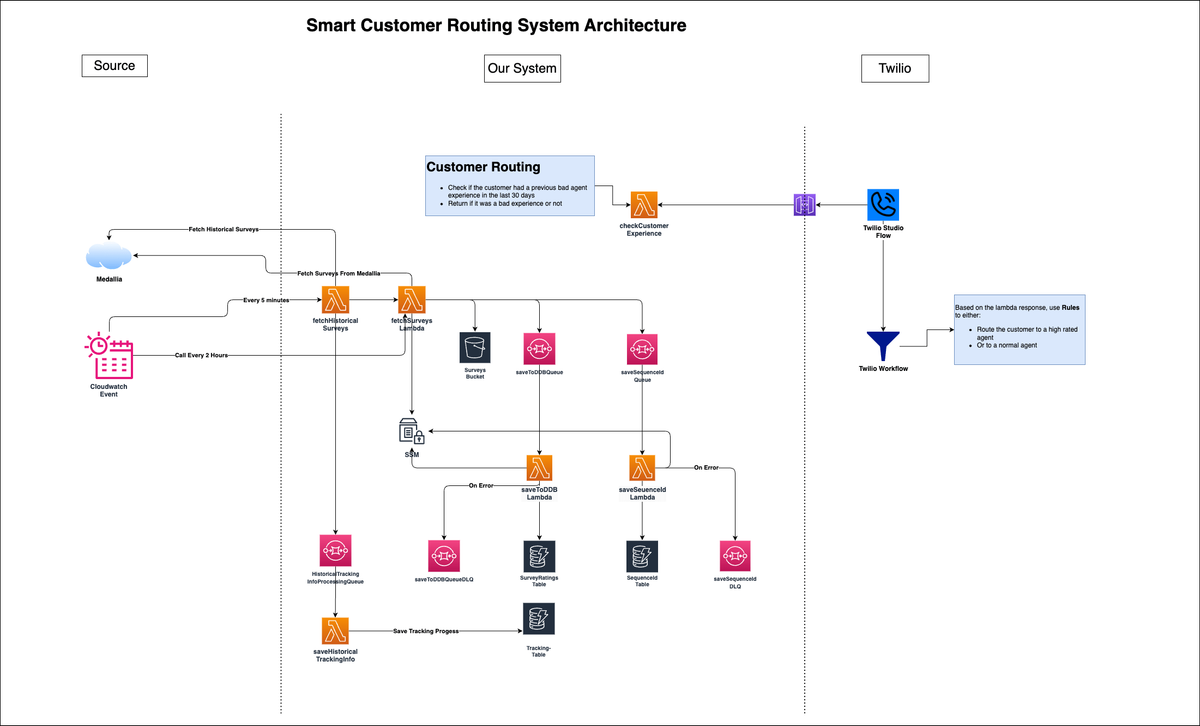
Core Architecture Principles
- Event-Driven Design: Decoupled components using SQS queues
- Serverless First: AWS Lambda for compute with automatic scaling
- Fault Tolerance: Idempotent operations and retry mechanisms
- Cost Efficiency: DynamoDB autoscaling + TTL for data lifecycle management
Data Model Design
MedalliaSurveyRatingsTable (DynamoDB)
Partition Key: uuid (String)
Sort Key: agent_custom_id (String)
GSIs:
- CustomerExperienceIndex (customer_email, response_received_at)
- BrandIndex (brand, agent_star_rating_value)

Attributes Track:
- Customer experience markers (is_bad_experience)
- Temporal data (response_received_at)
- Agent performance metrics (agent_star_rating_value)
- TTL (1 year automatic expiry)
Sequence Tracking Table
MedalliaSequenceIdTable:
- Static partition key ("last_sequence_id")
- Tracks sequence_id and historical_last_sequence_id
- Enables incremental data fetching
Key Components
1. Data Ingestion Pipeline
- Historical Data Processing (5-minute intervals)
- Near Real-Time Processing (2-hour intervals):
- Incremental updates using sequence IDs
- S3 → DynamoDB via saveToDDB Lambda
2. Experience Check Service
checkCustomerExperience Lambda (Twilio Integration):
// Query pattern for experience check
const params = {
  TableName: MEDALLIA_SURVEY_RATINGS_TABLE,
  IndexName: CUSTOMER_EXPERIENCE_INDEX,
  KeyConditionExpression:
    "customer_email = :email AND response_received_at > :date",
  FilterExpression: "is_bad_experience = :true",
  ExpressionAttributeValues: {
    ":email": "customer@example.com",
    ":date": "2023-01-01T00:00:00Z",
    ":true": true,
  },
  Limit: 1,
};
Fault Tolerance Mechanisms
- SQS Dead Letter Queues: Automatic retries for failed message processing
- Idempotent Operations: Sequence ID tracking prevents duplicate processing
- TTL Auto-Cleanup: DynamoDB automatic item expiration
- Circuit Breakers:
- Historical data toggle via AWS Systems Manager (SSM)
- Date boundary checks in Lambda functions
Performance Metrics
| Component    | Scale Target                | Availability |
| ------------ | --------------------------- | ------------ |
| DynamoDB     | 10,000 WCU/RCU              | 99.99%       |
| Lambda       | 1,000 concurrent executions | 99.95%       |
| SQS          | 10,000 messages/sec         | 99.95%       |
| Twilio Check | <100ms latency              | 99.9%        |
Lessons Learned
- GSI Optimization: CustomerExperienceIndex reduced query latency by 83%
- Batch Processing: S3 batch writes improved throughput by 40x vs direct DDB writes
- Sequence Management: Hybrid approach (sequence IDs + timestamps) prevented data gaps
- Cost Control: TTL implementation reduced storage costs by 65% annually
Future Enhancements
- Real-time streaming with Kinesis Data Streams
- Machine Learning-powered routing recommendations
- Multi-region deployment for global customers
- Automated quality assurance workflows
Conclusion
This system currently processes over 2.5 million survey records daily with p99 latency of 120ms for experience checks. By combining AWS serverless services with Twilio's communication platform, we've created a cost-effective solution that scales automatically with customer demand while maintaining strict SLAs.